

Blogs
Black Future Food: Celebrating culture while shaping the future
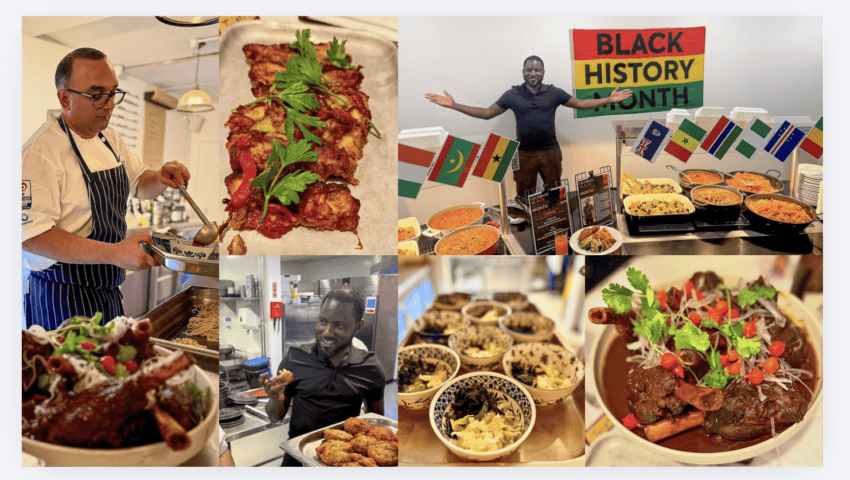
Food is as much about who gets a seat at the table as it is about taste.
As caterers, our goal is to increase support our clients, to provide their teams with a space to connect, to bring people together; and food is our most powerful tool. During October, I am naturally proud when I see more dishes from Black culture on our counters.
However, a recent conversation with our Chef Director, Pete Redman, really stuck with me. Over a familiar plate of rice and peas, Pete noted “I feel like our industry’s approach is just so tick-boxy”.
And he’s not wrong.
The same familiar dishes appear on menus, often for just one day, before disappearing again for another year. There is only so much jerk chicken and jollof rice we can plate and feel that’s a meaningful representation of Black food culture.
I am not here to negate that these popular dishes deserve their place, but instead to recognise that they represent only a really small part of a much bigger story.
Black food culture encompasses the global African diaspora, stretching across Africa, the Caribbean, Latin America, North America, Europe and beyond. It represents an extraordinary breadth of nations, communities, ingredients, techniques and traditions. Why as food experts, have we traditionally only offered dishes from 1% of the diaspora?
If food and people are truly at the heart of our business, we have a responsibility to look beyond the one narrow idea of “Black food” we have fostered because some food is more readily accepted as palatable than others. Space should be created for more dishes, more cultures, and more voices. It’s also can’t be confined only to October, but that we proudly weave ingredients and techniques throughout the year and across our business.
Pete’s challenge has empowered me to explore how we could make that change, how we can weave ingredients and techniques onto our menus throughout the year – what Black food could look like as a staple on our menus.
How could we give our teams the confidence to explore uncharted waters, and the courage to approach these conversations sensitively?
Moving beyond the familiar
Food is more than something we eat. It carries memories and connects us to the people and places that came before us.
Chatting to Pete made me realise that we all have our own ways of preserving memories. Coming from a Trinidadian home, I was taught that meals are shared. No matter what came our way, our mum’s cooking brought us together. Food transports us to a place, a moment, or a person. When I cook my mum’s dishes, I am taken home. I want to keep my childhood memories alive, and I wish I had had the courage to incorporate more of these techniques into my food earlier in my career.
Pete shared with me that some of his fondest childhood memories are of the banana cream pie his dad always ordered from their local diner; it was his dad’s way of preserving a memory and tradition despite being halfway round the world.
Like my mum’s cooking, for many Black families, recipes are passed down through generations. Traditional ingredient names, preparation methods and skills are an inherited pillar of identity.
However, a small number of familiar dishes can quickly become shorthand for an entire culture. The popularity of jerk and jollof is not up for debate, but our industry’s approach to it is.
Turning an idea into action
As caterers, our task is to balance cultural integrity and creativity with operational and commercial realities.
Pete asked me to develop a concept that could preserve the roots of a dish while presenting it differently, make unfamiliar ingredients more accessible and give more people a platform to share their heritage.
My response was Black Future Food: a concept that triumphs the past, tests the boundaries and humbly considers where Black food culture could go next.
The Black Future Food supper club was my first opportunity to test this. It is by no means a finished answer.
On the menu
Pete and I worked with Guyanese chef Natasha Renoo to explore how we could present a wider variety of traditional dishes in different ways to new audiences.
The intention was to provoke curiosity and bring new stories to light. Jollof rice sushi placed a familiar West African dish in an unexpected format, while my Trinidadian-inspired brown-stew lamb shank showcased the depth of flavour associated with Caribbean cooking.
Guyana’s colonial past has clearly influenced it’s cuisine and Natasha’s Egg Balls are a play on the British classic, a Scotch egg, but instead of pork, cassava is used; a really clever twist
“Guyanese people take pride and love in their recipes. Our food is rich in family stories and heritage. It unites us, and I want to feel like I can cook more dishes which show who I am.”
Natasha Renoo
Layered with malt and a crunchy, fried chicken-inspired coating, then served with Supermalt crémeux “gravy”, my fried-chicken ice cream challenged expectations of what Black British food can look like. Its playful presentation turned ingredients I adore into something unexpected and thought-provoking.
Looking to the future
Black Future Food cannot exist solely as a planned marketing day for caterers. This narrow lens is restrictive and doesn’t promote growth. Its future lies in making Black food influences a considered and consistent part of menus across our business and create opportunities for us chefs to learn from one another.
Caribbean browning is a great example – it’s the way my mum browned meat, by caramelising it in sugar she’d deepen its colour and enhance its caramel notes. It is a technique I grew up with and I recently shared with Pete who was blown away by the depth of flavour it creates. He’s now incorporating it into his own cooking and keen to explore other cultural techniques. That exchange would not have happened without the space to explore and share my heritage during the supper club.
Moving food forward is about recognising the memories, knowledge and cultural contributions while ensuring we can hear more voices from the diaspora, not just the ones we think will draw a crowd.
More stories from our blog
How winning the BM Barista Championship took Calvin to Brazil
Planting his own coffee tree on a farm in Brazil wasn’t something Calvin ever thought he’d get the chance to
5 Food trends shaping workplace dining this Autumn
October brings a familiar wave of pumpkin spice and crumbles, but this year, the trends shaping food and beverage go
Meet the Directors: welcoming new team members to BM
Starting a new job is exciting, but it can also feel a little daunting. That is why every new BM
Whole foods, UPFs and the missing nuance
Recent discussions on social media have put ultra-processed foods (UPFs) firmly in the spotlight, with many linking them to a